Posts

Showing posts with the label Eastern Orthodoxy

Eastern Orthodox Ecclesiological Presuppositionalism: A Mistaken Foundation

Image
Some Eastern Orthodox apologists have sought to adapt a form of Presuppositionalism in their defense of the Eastern Orthodox Church (EOC). Eastern Orthodox Presuppositionalism (EOP) is an ecclesiological epistemology, and even narrower still it is a sectarian epistemology, i.e. anti-catholic. In other words, according to EOP, the epistemological ground or cause of knowledge is said to be rooted in Eastern Orthodox ecclesiology, for EOP holds that the EOC is a precondition of intelligibility and knowledge. In contrast, Reformed Presuppositionalism (RP) is rooted in the Verbum Dei , with its epistemological ground seen to be God’s Word, and its epistemological consequence being unto and causative of ecclesiology. Put more simply, the RP position is that we can know the Church because of the transcendentally fundamental nature of God’s Word, not vice versa. The EOP position is that we know God’s Word because of the Church, thus causing the Scriptures and epistemology to submit to the Chu...

Anathema: Eastern Orthodoxy and The Ritual Cursing of All Other Christians

Image
  Many have been told that Eastern Orthodox Christianity is a welcoming, mystical version of Christianity, one that is not “hung up” on legalism or on excessive dogmatism. It may come as a surprise, then, to learn that Eastern Orthodox Christians not only formally believe that they are the only Christians on planet earth (Synod of Jerusalem of 1672, Decree 10), but that Eastern Orthodox Christians are called to ritually and formally curse, every year, all who disagree with them. The canonical document that they use to curse all non-Orthodox is called the Synodikon of Orthodoxy , and technically is supposed to be read yearly on the Feast of Orthodoxy, also called the Sunday of Orthodoxy, and the Triumph of Orthodoxy. From the titles of the Feast Day on which it is read, it is clearly being associated with the very identity of Eastern Orthodox Christianity, and of what it means to be an Eastern Orthodox Christian. It is celebrated on the first Sunday of Great Lent in the Eastern Orth...

Poetic Licence: Eastern Orthodoxy and Mariological Metaphor

Image
Many in the Eastern Orthodox Church will make the claim that the hyperbolic ascriptions given to Mary are simply metaphors. As such, when Mary is called in the Akathist Hymn dedicated to her a “propitiation for the whole world,” it is explained away as meaning something other than what it is saying . The problem with this is typically defined by the Orthodox as being that Protestants simply do not understand how metaphor works. In short, Protestants are too obtuse. There is, however, another possibility, and that is that Eastern Orthodox Christianity teaches falsely about Mary, and explains away their obvious errors by calling them “metaphors” in order to avoid the painful reality that they have departed from the truth as given in the clear witness of holy Scripture. In order to get a better picture of the situation, it could be helpful to look at the manner in which Scripture uses metaphor. One famous example given in the Bible is that of Jesus being a ransom . This metaphor is based...

Additae Salvator: On the Eastern Orthodox Doctrine of Mary as Another Savior

Image
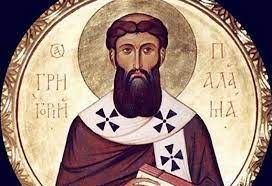
Gregory Palamas teaches of the blessed virgin Mary: “She alone forms the boundary between created and uncreated nature, and no one can come to God except through her and the mediator born of her, and none of God’s gifts can be bestowed on angels or men except through her. As in the case with lamps on earth constructed of glass or some other transparent material, it is impossible to look at the light or enjoy its rays except through the lamp, so it is beyond the reach of all to look upwards to God or be helped by Him to make progress in any direction, except through the Ever-Virgin, this God-bearing lamp who is truly radiant with divine brightness.” ( The Homilies , "On the Entrance into the Temple," 53.37, pg 431; cf. Homily 37.15, 17, 18, pgs 296-297) The relevant portion of Homily 37, "On the Dormition," 37.15 reads: “She alone stands at the border between the created and uncreated nature, and no one can come to God unless he is truly illumined by her, the true la...

Of Rock and Sand: A Critique of Josiah Trenham’s Appraisal of Protestantism

Image
Introduction In his attempt at growing the Orthodox Church, Archpriest Josiah Trenham has made a name for himself as a relatively erenic interlocutor with Protestant, Reformed, and Evangelical Christians of multiple stripes. In claiming common ground with them, he makes mention in an interview of his time as a student at Westminster Seminary under RC Sproul, where he became attracted to ( here ), if not convicted of ( here ), what he saw as the truth of Eastern Orthodoxy. According to his testimony, he even began his earnest search into Orthodoxy prior to going to seminary, planning his seminary studies ahead of time to coordinate with this specific search ( here ). He was even known at seminary for not likely continuing in the faith of his seminary ( here ). The significance of this background seems to be that, although Trenham states to have come from a Reformed background, it is clear from his testimony that he had notably departed in spirit from Reformed Christianity already durin...