Posts

Anathema: Eastern Orthodoxy and The Ritual Cursing of All Other Christians

Image
  Many have been told that Eastern Orthodox Christianity is a welcoming, mystical version of Christianity, one that is not “hung up” on legalism or on excessive dogmatism. It may come as a surprise, then, to learn that Eastern Orthodox Christians not only formally believe that they are the only Christians on planet earth (Synod of Jerusalem of 1672, Decree 10), but that Eastern Orthodox Christians are called to ritually and formally curse, every year, all who disagree with them. The canonical document that they use to curse all non-Orthodox is called the Synodikon of Orthodoxy , and technically is supposed to be read yearly on the Feast of Orthodoxy, also called the Sunday of Orthodoxy, and the Triumph of Orthodoxy. From the titles of the Feast Day on which it is read, it is clearly being associated with the very identity of Eastern Orthodox Christianity, and of what it means to be an Eastern Orthodox Christian. It is celebrated on the first Sunday of Great Lent in the Eastern Orth...

Poetic Licence: Eastern Orthodoxy and Mariological Metaphor

Image
Many in the Eastern Orthodox Church will make the claim that the hyperbolic ascriptions given to Mary are simply metaphors. As such, when Mary is called in the Akathist Hymn dedicated to her a “propitiation for the whole world,” it is explained away as meaning something other than what it is saying . The problem with this is typically defined by the Orthodox as being that Protestants simply do not understand how metaphor works. In short, Protestants are too obtuse. There is, however, another possibility, and that is that Eastern Orthodox Christianity teaches falsely about Mary, and explains away their obvious errors by calling them “metaphors” in order to avoid the painful reality that they have departed from the truth as given in the clear witness of holy Scripture. In order to get a better picture of the situation, it could be helpful to look at the manner in which Scripture uses metaphor. One famous example given in the Bible is that of Jesus being a ransom . This metaphor is based...

Veneration vs. Worship: A Lesson in the Humor of Casuistry

Image
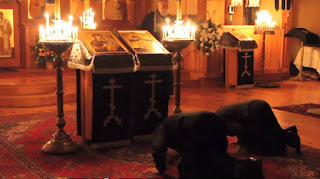
When Romans Catholics and Eastern Orthodox say, "We are not worshiping Mary," and "We are not worshiping icons," the tragic reality is that too many will do X but call it Y. It is like watching them pour water into a cup while they insist on saying, "No, you are misled, I am just pouring water into the space above the cup, and it is only an accidental property of my pouring that it goes into the cup, and really the metaphysical substance of the cup is the matter itself, not the space qua space of the cup, and I am not pouring the water into the substance of the cup. You have been deceived into thinking I am pouring water into the cup."  All one can say to this is, “Thy cup runneth over.” They retort, “Sir, you must be one of those deceived Protestants. In truth, I am not ‘pouring’ the water. We reserve a distinction that pouring is only true pouring when the pouring device has either a lip on the side or a spout. Clearly neither of those conditions are be...

Ad Hoc: Assessing John of Damascus’ Argument for Icon Veneration

Image
Having dealt elsewhere with the innovative nature of icon veneration as a historical phenomenon in the Medieval Eastern Church, it is also important to ask: What is John of Damascus’ fundamental argument in support of the veneration of icons? Looking especially at the first of his three treatises in defense of icons, focusing on paragraphs four through eight where he provides the foundation of his argument, and beginning with the Old Testament dispensation (i.e. prior to the Incarnation), his first syllogism is basically this: 1) In regards to God, one is not allowed to depict what is invisible. 2) God was invisible in the Old Testament dispensation. 3) Therefore, one could not depict God in the Old Testament dispensation. He argues that “it is impossible to depict God who is incommensurable and uncircumscribable and invisible” (1.7). For since God had not yet become Incarnate, it was implicitly impossible to depict His Person, for none of the means by which He had revealed Himself pr...